
Kales at Kangema Farm Life
Crop overview
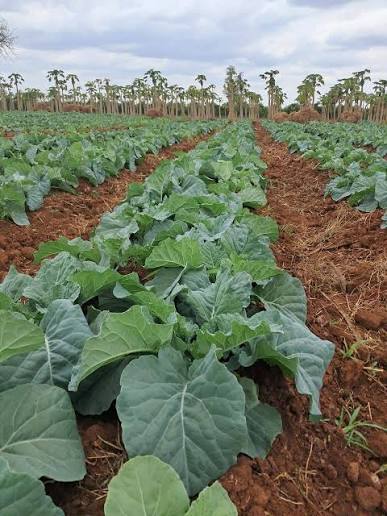
Kale, known in Kenya as sukuma wiki, is a leafy vegetable from the cabbage family. Plants are harvested again and again by picking the lower leaves, so one planting can give leaves for many months.
Importance of the crop
Sukuma wiki is one of the most eaten vegetables in Kenya, so demand is steady all year in homes, schools, hotels and markets. It is relatively easy to grow and gives regular income from frequent harvests.
Suitable climate
Kales grow well in cool to moderate temperatures and do well in the highlands. They tolerate a wide range of conditions but need water in dry spells. Very hot weather slows growth and toughens the leaves.
Verify locally: figures, varieties and product choices differ by altitude, season and variety. Confirm with your county agricultural extension officer or KALRO before acting.
Soil requirements
Kales prefer fertile, well-drained soil rich in organic matter. Avoid fields where cabbage-family crops grew recently, to reduce pests and diseases such as clubroot and black rot.
Land preparation
Clear and dig the land well, removing weeds and old crop remains. Mix in well-decomposed manure or compost before planting. On slopes, plant along the contour.
Seed and seedling selection
Use certified seed of a variety that suits your market, for example for leaf size, colour and taste. Ask your supplier about the varieties that perform best in your area.
Verify locally: figures, varieties and product choices differ by altitude, season and variety. Confirm with your county agricultural extension officer or KALRO before acting.
Nursery management
Sow in a clean nursery bed or trays, cover lightly and keep moist. Thin crowded seedlings and watch for damping-off and early pests. Harden off before transplanting. See our nursery guide.
Transplanting
Move strong seedlings in the evening or on a cloudy day. Water the holes, plant at the nursery depth, firm the soil and water immediately.
Spacing
Follow the spacing recommended for your variety. Good spacing lets air move between plants, which reduces disease, and gives room for the leaves to grow large.
Verify locally: figures, varieties and product choices differ by altitude, season and variety. Confirm with your county agricultural extension officer or KALRO before acting.
Fertilizer and manure
Kales respond well to nitrogen, which drives leaf growth. Use manure or compost at planting and top-dress during the season, guided by a soil test and extension advice. See organic manure and compost.
Verify locally: figures, varieties and product choices differ by altitude, season and variety. Confirm with your county agricultural extension officer or KALRO before acting.
Irrigation
Water regularly, especially in dry spells, so that leaf production does not stop. Drip or careful furrow irrigation works well. Mulch helps hold moisture.
Weed management
Keep the field weed-free, especially in the first weeks after transplanting. Weeds compete for nutrients and hide pests.
Pest management
Watch for aphids, diamondback moth caterpillars, cabbage webworm, cutworms and whiteflies. Scout weekly, especially under the leaves. If you must spray, use only products registered for kales in Kenya and respect the pre-harvest interval, as leaves are picked often. See pest management.
Verify locally: figures, varieties and product choices differ by altitude, season and variety. Confirm with your county agricultural extension officer or KALRO before acting.
Disease management
Common diseases include black rot (yellow V-shaped patches at the leaf edges), downy mildew, Alternaria leaf spot, clubroot and damping-off. Use clean seed, rotate away from cabbage-family crops, and remove diseased leaves and plants.
Verify locally: figures, varieties and product choices differ by altitude, season and variety. Confirm with your county agricultural extension officer or KALRO before acting.
Common problems and solutions
| Problem | What to do |
|---|---|
| Holes in the leaves | Often diamondback moth or other caterpillars. Scout and act early. |
| Yellow V-shaped patches at the leaf edge | Possible black rot. Remove affected leaves and rotate away from the cabbage family. |
| Sticky, curled young leaves | Aphids. Check under the leaves and encourage natural enemies. |
| Swollen, deformed roots and wilting | Possible clubroot. Do not plant cabbage-family crops there for a long time and improve drainage. |
| Seedlings cut at the base | Cutworms. Check the soil around plants in the evening. |
Harvesting
Start picking once plants are well established. Pick mature lower leaves, leaving the growing tip and young leaves to keep producing. Harvest regularly to keep the plant productive.
Post-harvest handling
Pick in the cool of the morning, keep leaves in the shade and avoid crushing them. Bundle neatly and sell quickly, as leaves wilt fast.
Expected production
Yields depend on variety, management and how long the crop is harvested, so we do not quote a figure. Record each harvest to learn what your field produces.
Verify locally: figures, varieties and product choices differ by altitude, season and variety. Confirm with your county agricultural extension officer or KALRO before acting.
Marketing
Local markets, schools, hotels and households buy kales every day. Regular, fresh supply builds loyal customers. Planting in batches gives a steady supply.
Frequently asked questions
How long can I keep harvesting kales?
For many months if plants are healthy, watered and fed. Remove plants that become weak or diseased.
Can kales follow cabbages?
It is better not to: they are the same family and share pests and diseases. Rotate with beans, onions or the tomato family.
Why are my leaves small and pale?
Usually a lack of nitrogen or water. Feed and water regularly.
Buying kales (sukuma wiki)? See it on our Products page or ask us on WhatsApp about availability.
Questions about our produce or farming?
Talk to us on WhatsApp or send a message. We reply as soon as we can.